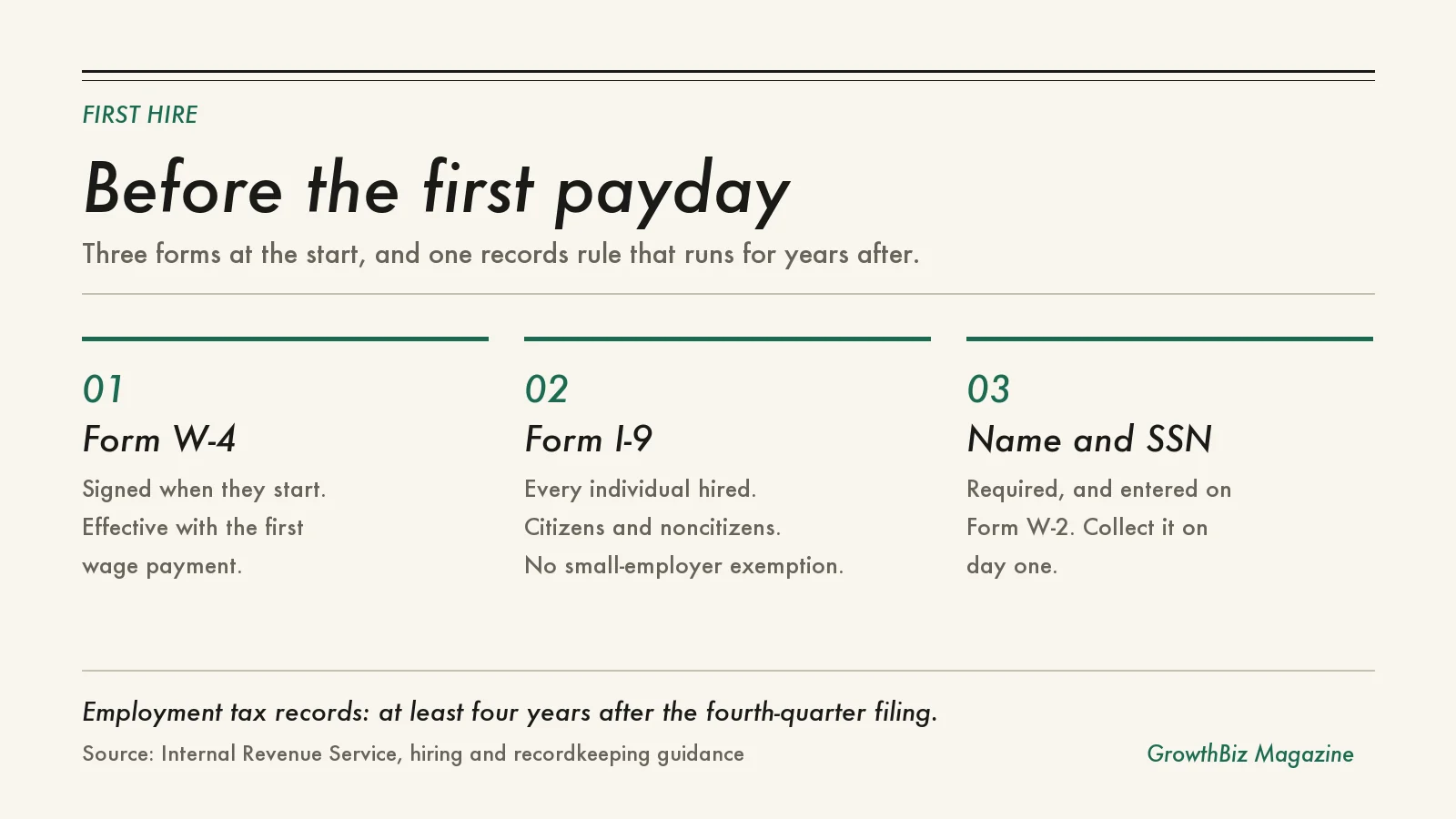
- Form W-4 is collected when the employee starts, and it takes effect with the first wage payment.
- Form I-9 applies to every hire, citizen or not, with no exceptions for small employers.
- Employment tax records must be kept at least four years after the fourth-quarter filing, and the IRS lists exactly which records those are.
The decision is the hard part. Once you have made it, the paperwork is short, specific, and mostly front-loaded. This is what the IRS actually requires, in the order you will need it.
One thing to settle first: this assumes the person is an employee rather than an independent contractor. If you are not certain which of the two they are, that classification is a separate question with its own test, and it determines everything below.
Form W-4, at the start
The IRS instruction is plain: "Ask all new employees to give you a signed Form W-4 when they start work. Make the form effective with the first wage payment."
So it is collected before payday, not at year end. There is also a rule for later changes. If an employee hands you a W-4 that replaces an existing one, you "begin withholding no later than the start of the first payroll period ending on or after the 30th day from the date you received the replacement Form W-4."
Read that as a deadline, not a suggestion. Thirty days is generous. Losing the form on someone's desk for six weeks is not.
Form I-9, for everyone
This one has no small-employer exemption. The IRS states that "all U.S. employers must properly complete Form I-9 for every individual they hire for employment in the United States. This includes citizens and noncitizens."
Note the wording: every individual, and both citizens and noncitizens. Businesses sometimes assume the form is only for people who look like they might need it. That assumption is both wrong and the exact shape of a discrimination problem.
Name and Social Security number
You are required to get each employee's name and Social Security number, and to enter them on Form W-2. The IRS notes this applies to resident and nonresident alien employees as well.
Collect it at the start, and check it matches their documents while you have them in front of you. A mismatch found in January is a correction. A mismatch found at hire is a question.
The records you must keep, and for how long
This is the part that outlives the hire. The rule is to "keep all records of employment taxes for at least four years after filing the 4th quarter for the year."
The IRS also publishes what those records are, which is more useful than the period on its own. It is a longer list than most first-time employers expect.
| Keep | Note |
|---|---|
| Employer identification number | Needed on every filing |
| Amounts and dates of all wage, annuity and pension payments | Dates as well as amounts |
| Names, addresses, Social Security numbers and occupations of employees | The IRS names occupation too |
| Dates of employment for each employee | Start and end |
| Copies of withholding certificates (Forms W-4, W-4P, W-4S, W-4V) | Not just the current one |
| Employee copies of Form W-2 and W-2c returned as undeliverable | Keep the ones that came back |
| Amounts of tips reported, and any allocated tips | Where tips apply |
| Fair market value of in-kind wages | Non-cash pay still counts |
| Periods of paid absence for sickness or injury, with amounts | Dates and payments |
| Dates and amounts of tax deposits, with EFTPS acknowledgment numbers | The acknowledgment number, not just the payment |
| Copies of returns filed, with confirmation numbers | Both |
| Records of fringe benefits and expense reimbursements | Often the forgotten one |
Two entries on that list are the ones small employers usually miss. The EFTPS acknowledgment number is a record in its own right, not just proof that money moved. And undeliverable W-2 copies are kept rather than binned.
Setting it up so it keeps working
The paperwork is a one-week job. The records rule runs for years. Build for the second one.
- One folder per employee, opened on day one. W-4, I-9, name and SSN, start date. It takes ten minutes at the start and hours to reconstruct later.
- One folder per quarter for deposits and filings. Deposit dates, amounts, EFTPS acknowledgment numbers, the return, the confirmation number.
- Label each quarter folder with its destroy-after year. Four years after the fourth-quarter filing, not four years after the transaction.
- Record anything paid that was not cash. In-kind wages and fringe benefits both appear on the IRS list, and they are the entries businesses most often overlook.
If you use a payroll provider, most of this is generated for you. The obligation to retain it remains yours regardless. A provider you leave in two years is not a records system.
A note on scope: this covers United States federal requirements as the IRS publishes them, and only the ones the pages cited below actually state. Getting an employer identification number, state new-hire reporting, state withholding registration, unemployment insurance and workers' compensation are all separate and are not covered here. Nothing on this page is tax or legal advice for a specific business.
Frequently asked questions
Do we need a W-4 if the employee is part time?
The instruction is to ask all new employees for a signed W-4 when they start work. It does not distinguish by hours.
Can we file the I-9 with a government agency?
The requirement is to properly complete it for every individual you hire. It is a form you complete and retain, not one you send in.
The four years run from when, exactly?
From filing the fourth quarter for the year, so it is the filing date that starts the clock rather than the pay date.
What if the employee's name and SSN do not match?
You are required to get the name and Social Security number and to put them on the W-2. Resolve a mismatch with the employee before it reaches a filing.
Sources
IRS, Hiring employees · IRS, Employment tax recordkeeping. Quoted wording and the records list are the IRS's own. Read alongside our guide to record retention periods, which sets the four-year employment tax rule against the other periods, and the employee-or-contractor test, which decides whether any of this applies at all.