- The deciding question is control: an independent contractor is engaged for the result of the work, not for how and when the work gets done.
- A signed contract, a job title or issuing a 1099-NEC does not settle the classification; the IRS states no single factor decides it.
- Getting it wrong is an employment tax exposure, not a paperwork slip, so document the reasoning for each engagement while you still remember it.
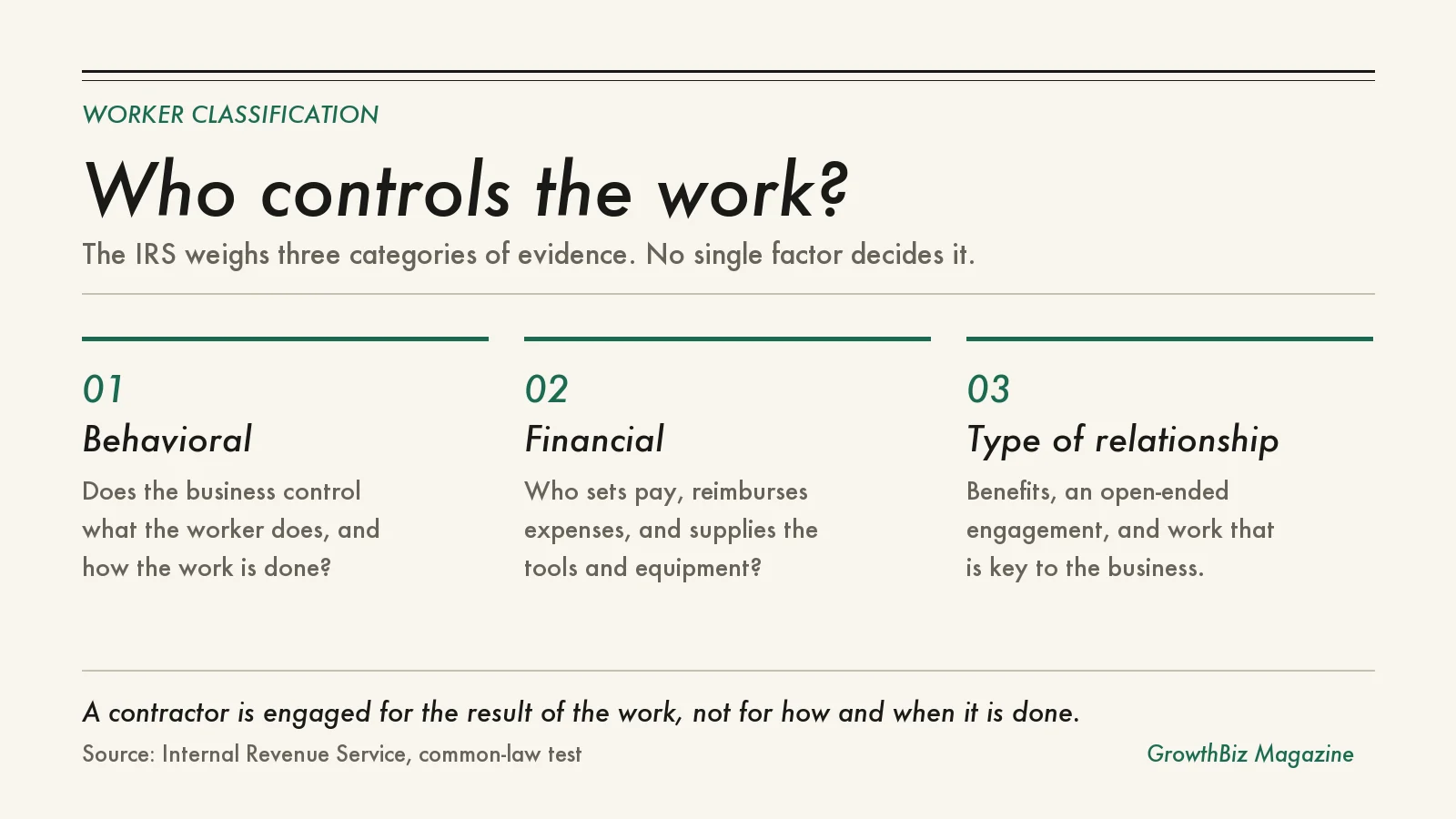
The question is narrower than it looks. The IRS turns on a single idea: who controls the work. Its own definition is that a worker "is an independent contractor if the person for whom the services are performed has the right to control or direct only the result of the work and not what will be done and how it will be done." Engage someone for an outcome and you are probably dealing with a contractor. Direct the method, the hours and the sequence, and you are probably dealing with an employee, whatever the agreement says.
That distinction carries a concrete consequence. A business generally must withhold and deposit income tax, Social Security and Medicare taxes from an employee's wages, and generally does not withhold or pay those taxes on payments to an independent contractor. The classification decides who carries the tax obligation, which is why the IRS takes an interest in it.
The three categories of evidence
The IRS does not score a checklist. It groups the facts of a relationship into three categories of evidence and weighs the whole picture. These are the questions it asks, in its own words.
| Category | The question the IRS asks | What tends to point to employment |
|---|---|---|
| Behavioral control | Does the company control or have the right to control what the worker does and how the worker does the job? | Set hours, prescribed methods, required training, close supervision |
| Financial control | Are the business aspects of the worker's job controlled by the payer, including how the worker is paid, whether expenses are reimbursed, and who provides tools and supplies? | Hourly pay for time rather than a fee for a deliverable, expenses reimbursed, tools supplied by the business |
| Type of relationship | Are there written contracts or employee-type benefits such as a pension plan, insurance or vacation pay? Will the relationship continue, and is the work performed a key aspect of the business? | Benefits provided, open-ended engagement, work that is core to what the business sells |
Note the phrase "or have the right to control" in the first category. The right matters even where it is never exercised. A contract that reserves the power to direct the method is evidence of that right, regardless of how relaxed the day-to-day relationship is.
What does not decide it
Three things are commonly treated as settling the question, and none of them do.
The contract. A document titled "Independent Contractor Agreement" is a fact in the third category, not a conclusion. The IRS is explicit that "there is no 'magic' or set number of factors that 'makes' the worker an employee or an independent contractor and no one factor stands alone in making this determination."
The job title, or the worker's preference. Neither is a category of evidence. A worker who asks to be paid as a contractor does not change who controls the work.
Issuing a 1099-NEC. Reporting payments to a contractor on Form 1099-NEC in box 1 is what you do because of a classification. It is not what creates one.
Working through an actual engagement
The practical method is to write down the facts before you write down the label. Take one engagement and answer these in plain sentences, keeping the three categories in view.
- What did you buy? A defined deliverable, or a person's time? If you cannot describe the finished thing you are paying for, you are probably buying time.
- Who decides how it gets done? If your answer includes a method, a tool or a schedule you require, that is behavioral control.
- Who bears the cost of doing it? Who supplies equipment, software and workspace, and are expenses reimbursed? A contractor typically carries their own costs and prices them in.
- Can they profit or lose on the engagement? A fixed fee against their own costs creates real financial risk. An hourly rate with reimbursed expenses does not.
- Is it open-ended? A relationship expected to continue indefinitely points toward employment.
- Is the work a key aspect of the business? The IRS names this explicitly. A restaurant's cooks sit differently from its once-a-year sign painter.
- Are there benefits? Pension, insurance or vacation pay are named employee-type benefits.
Keep the answers with the engagement file. If the classification is ever questioned, the contemporaneous reasoning is the evidence, and it is far harder to reconstruct two years later.
If you are genuinely unsure
Two formal routes exist, and both have a cost worth knowing before you choose.
Form SS-8 asks the IRS to determine a worker's status. Either the business or the worker can file it. The IRS's own guidance is that it may take at least six months to receive a determination, so it is a route for a recurring pattern you need settled, not for a hiring decision due next week.
The Voluntary Classification Settlement Program is for a business that concludes it has been classifying workers wrongly and wants to fix it going forward. The IRS describes it as offering partial relief from federal employment taxes for eligible businesses that prospectively reclassify workers as employees.
Why this is a financial question, not an administrative one
Misclassification is not a filing error that gets corrected with an amended form. Where workers treated as contractors are found to be employees, the business faces employment tax liability for the amounts it should have withheld and deposited. The exposure scales with headcount and with time, which is what makes an unexamined "we use contractors" policy expensive: the same reasoning error is repeated across every engagement and every quarter it goes unreviewed.
The proportionate response is a review, not alarm. Take the list of everyone the business paid last year who was not on payroll, run the seven questions above against each, and separate them into three groups: clearly contractors, clearly employees, and genuinely uncertain. The first group needs a file note. The second needs fixing. Only the third needs professional advice, and it is usually much shorter than founders expect.
A note on scope: this covers United States federal tax classification under the IRS common-law test. Individual states apply their own tests for wage, unemployment and workers' compensation purposes, and some are stricter. Nothing here is legal or tax advice for a specific engagement.
Frequently asked questions
Can a worker be a contractor for one project and an employee for another?
The test applies to the relationship, so different engagements can in principle be classified differently. In practice, a person doing core work under direction most of the week is difficult to treat as a contractor for a slice of the same work.
Does a part-time worker default to contractor status?
No. Hours worked is not one of the three categories of evidence. A part-time worker whose method and schedule you direct is on the employee side of the test.
If the worker signs an agreement waiving employee status, are we protected?
No. A written contract is a fact within the third category, and the IRS states no single factor stands alone. A waiver does not move control.
How long should we keep the reasoning?
Keep it with the engagement records for as long as you retain the related tax records. The value of the note is that it was written at the time.
Sources
IRS, Independent contractor (self-employed) or employee? · IRS, Independent contractor defined. Quotations and the three categories of evidence are the IRS's own wording. Read alongside our itemised model for turnover cost, which assumes a settled classification before any hiring cost is estimated.