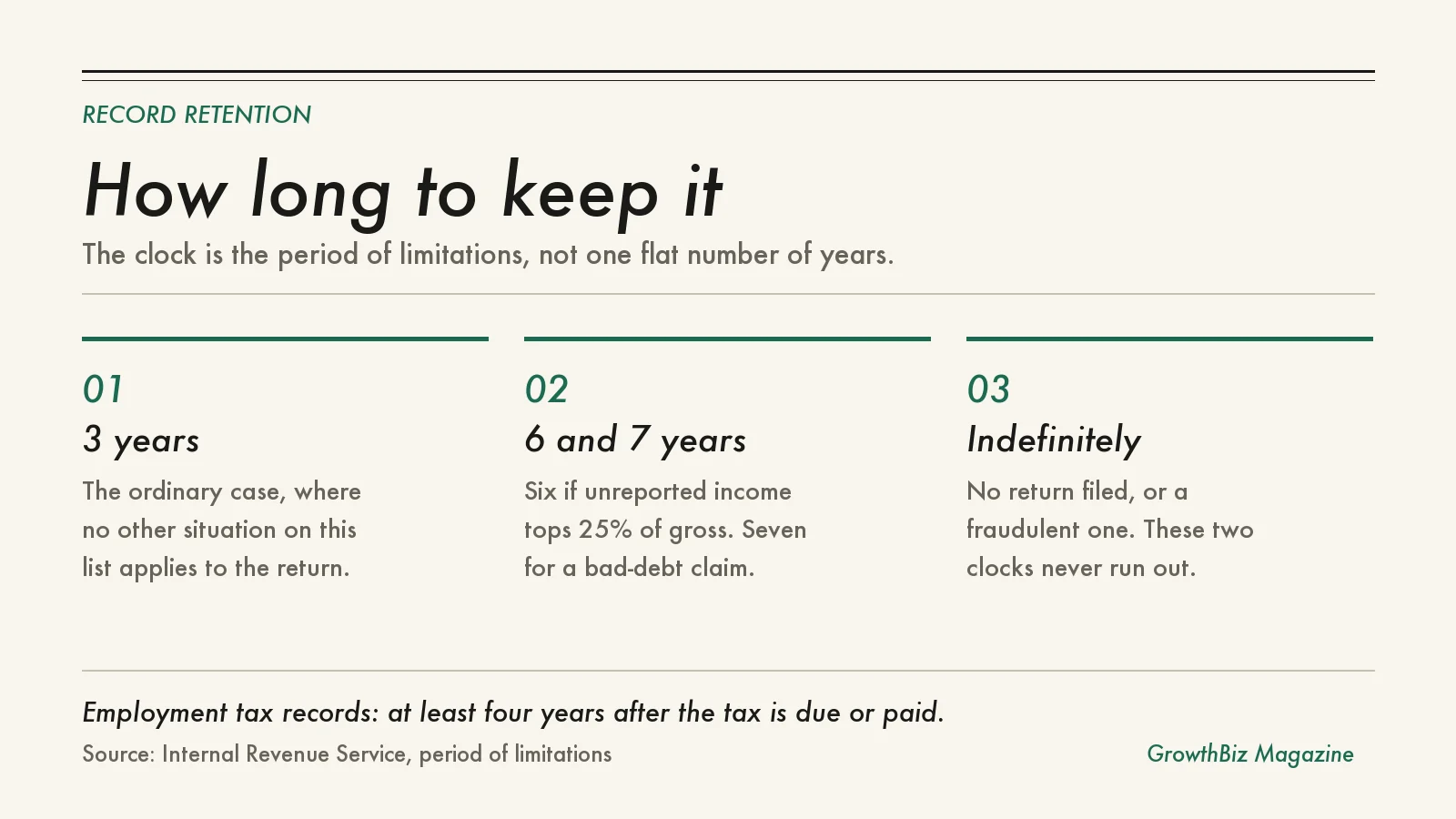
- The clock is not a flat number of years; it is the period of limitations for the return the record supports, which runs from three years to indefinitely.
- Employment tax records have their own floor: at least four years after the tax is due or paid, whichever is later.
- Tax is not the only clock. The IRS tells you to check whether an insurer or a creditor needs the record longer before you destroy anything.
There is no single answer. The common advice to "keep everything seven years" is both wrong and expensive. The IRS ties retention to one idea: keep the records that support an item "until the period of limitations for that tax return runs out." That period changes with the situation. For two situations it never runs out at all.
The practical consequence is that a business does not have one retention rule. It has a short one for most things, a longer one for a few, and a permanent one for the returns it never filed.
The periods, as the IRS publishes them
| Situation | Keep for |
|---|---|
| The ordinary case, where none of the situations below apply | 3 years |
| You file a claim for credit or refund after filing the return | 3 years from filing, or 2 years from when the tax was paid, whichever is later |
| You claim a loss from worthless securities or a bad debt deduction | 7 years |
| You do not report income you should, and it is more than 25% of the gross income shown on the return | 6 years |
| You do not file a return | Indefinitely |
| You file a fraudulent return | Indefinitely |
| Employment tax records | At least 4 years after the tax becomes due or is paid, whichever is later |
Read the fourth row carefully. It is the one that quietly changes a small business's retention policy. The six-year period is not triggered by deliberate concealment. It applies where unreported income exceeds a quarter of the gross income shown. A business that finds an omission later is inside that window either way.
Records about property have their own clock
The cost and history of an asset is not governed by the year you bought it. The IRS position is to keep property records until the period of limitations expires for the year in which you dispose of it. Those records are what compute depreciation, amortisation, and the gain or loss on the sale.
In practice this means the purchase invoice for a van bought in 2019 and sold in 2029 is live until well into the 2030s. Businesses that archive by purchase year rather than by asset routinely destroy exactly the document they need at sale.
Tax is not the only reason to keep something
Most retention policies miss this one. The IRS states it plainly: when records are no longer needed for tax purposes, "do not discard them until you check to see if you have to keep them longer for other purposes." It names insurers and creditors as examples.
Then add the obligations nobody files under record-keeping: a lender's covenant, a lease, a warranty claim, an employment dispute, a client contract with its own audit clause. Each carries a period of its own. None of them care what the tax rule says.
Turning that into a policy you will actually follow
The failure mode is not keeping too little. It is keeping everything, in no order, until nobody can find anything and nobody dares delete. A workable policy needs three decisions, not a filing cabinet.
- Decide what class each record belongs to. Most documents are ordinary support for a return. A much smaller set touches property, employment tax, or a bad-debt claim. Sort once, at the point of filing, not years later.
- Attach the destroy-after year at the moment you file it. A folder labelled "2026 — review 2030" takes seconds to create and removes the judgement call entirely when the date arrives.
- Keep a one-page list of non-tax obligations. Lender, insurer, landlord, biggest client. Note what each requires and for how long. This is the list that stops a correct tax-driven deletion from becoming a contractual problem.
Then review once a year, on a fixed date, and only touch the folders whose review year has arrived. Everything else stays shut.
The two files you never destroy
Two situations carry no expiry: a year in which no return was filed, and a return that was fraudulent. If either applies to your history, the supporting records stay indefinitely, and that is worth knowing before a well-meaning clear-out.
Separately, and for ordinary business reasons rather than tax ones, formation documents, share records, partnership agreements, property deeds and pension records are usually kept permanently. They are cheap to store and impossible to reconstruct.
A note on scope: these are United States federal tax retention periods as the IRS publishes them. States and other countries set their own. An insurer or lender can require longer. Nothing here is tax or legal advice for a specific business. Check the current IRS page each year: the periods are what matter, and they are published rather than inferred.
Frequently asked questions
Is scanning enough, or do we need the paper?
The retention period applies to the record, not to its format. What matters is that the copy stays complete, legible and retrievable for the whole period. In practice that means asking whether you can still open the file in 2033, not whether it is paper.
The seven-year rule everyone repeats: where does it come from?
It is a rounding of the longest common period. Seven years is the window for a worthless securities or bad debt claim. It is not the general rule, and it is not long enough for the two indefinite cases or for property you still own.
Do the periods start from the tax year or from filing?
From the return, not the calendar year the transaction happened in. For employment taxes specifically, the four years run from when the tax became due or was paid, whichever is later.
What if we are not sure which situation applies?
Keep the record and diary a review. Deleting is the only irreversible move in this process, and the storage cost of another year is trivial next to reconstructing a destroyed file.
Sources
IRS, How long should I keep records?. Every period above is the IRS's own, as published. Read alongside our guide to the estimated tax dates and safe harbours, since the returns those payments support are the records this schedule governs.