- You owe estimated tax payments if you expect to owe $1,000 or more on filing, or $500 or more for a corporation.
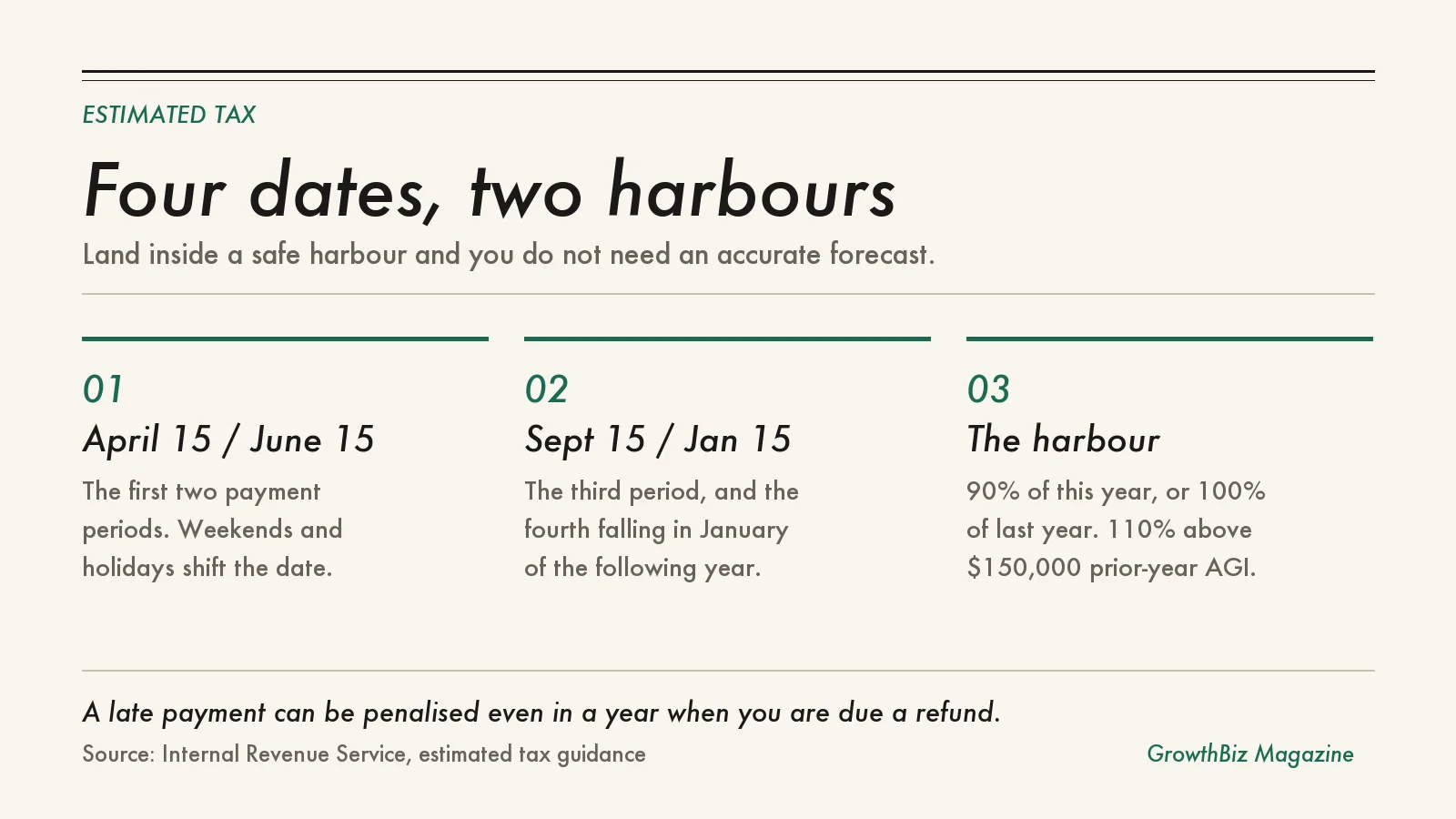
- The safe harbour is the smaller of 90% of this year's tax or 100% of last year's, rising to 110% if last year's AGI was over $150,000.
- A late payment can trigger a penalty even in a year when you are due a refund, which is why the dates matter more than the arithmetic.
Estimated tax is not an optional prepayment. The IRS position is that individuals, including sole proprietors, must make estimated payments if they "expect to owe tax of $1,000 or more when their return is filed", and corporations if they "expect to owe tax of $500 or more". Below those figures the requirement does not bite. Above them, the question stops being whether to pay and becomes how much, and by when.
The practical answer is that you do not need to forecast the year accurately. You need to land inside one of two safe harbours, and the smaller one is usually the easier target.
The four dates
The tax year is divided into four payment periods. The IRS states the due dates as April 15, June 15, September 15, and January 15 of the following year.
| Payment | Due | Covers |
|---|---|---|
| 1st | April 15 | The first period of the current year |
| 2nd | June 15 | The second period |
| 3rd | September 15 | The third period |
| 4th | January 15 of the following year | The final period |
One relief is built in. Where a due date falls on a weekend or a public holiday, the IRS allows that "the payment will be on time if you make it on the next day that's not a Saturday, Sunday, or legal holiday." Check the calendar each year rather than assuming the 15th; it moves.
Note the shape of the schedule. The gap between the January and April payments is three months, but the gap between April and June is two. Businesses that set a monthly reminder based on the first interval miss the second one, which is a common and entirely avoidable way to trigger a late payment.
The safe harbour, and which one applies to you
This is the part worth committing to memory, because it converts an unknowable forecast into a number you already have. The IRS states that you generally avoid the underpayment penalty if you "owed less than $1,000 in tax after subtracting their withholdings and credits, or if they paid at least 90% of the tax for the current year, or 100% of the tax shown on the return for the prior year, whichever is smaller."
Read that last clause carefully: whichever is smaller. You are not required to hit both. And there is a higher-income variant. Where the prior year's adjusted gross income exceeded $150,000, the prior-year figure becomes "110% of the tax shown on your prior year's tax return", and the threshold is $75,000 if married filing separately.
| Your situation | Pay at least | Why it is usually the easier target |
|---|---|---|
| Prior-year AGI $150,000 or below | The smaller of 90% of this year's tax or 100% of last year's | Last year's tax is a settled number on a filed return |
| Prior-year AGI above $150,000 ($75,000 if married filing separately) | The smaller of 90% of this year's tax or 110% of last year's | Still a known figure, just uplifted |
| Expecting to owe under $1,000 after withholding and credits | Nothing on account | The requirement does not apply |
For a business whose income is growing, the prior-year route is almost always the safer of the two, because it is a fixed number rather than a forecast. For a business whose income is falling, the 90% route can be substantially cheaper, but it depends on an estimate you will only be sure of in hindsight.
The trap that catches profitable years
The single most surprising line in the IRS guidance is this: "You also may have to pay a penalty if your estimated tax payments are late, even if you are due a refund when you file your tax return."
The penalty attaches to being late, not to being short overall. A business that pays nothing in April and June, then makes one large payment in September that covers the whole year, can still be penalised for the two missed periods. Paying the right total at the wrong time is not compliance.
This is why the operational fix matters more than the tax planning. Put the four dates in the calendar as fixed obligations with the amount attached, in the same place you keep payroll and rent. Treat them as bills, not as a year-end reconciliation.
Running it without a forecast
- Take last year's total tax from the filed return. Not last year's income. The tax line.
- Check last year's AGI. Above $150,000, or $75,000 if married filing separately, uses the 110% figure; otherwise 100%.
- Multiply and divide by four. That is your per-period payment for the prior-year safe harbour.
- Subtract any withholding. If you also draw a salary with tax withheld, that counts toward the total, so the estimated payments only need to cover the gap.
- Set the four calendar entries now, with the amount in the title, and check each year whether the 15th falls on a weekend.
- Revisit only if the year diverges sharply. If income drops hard, the 90%-of-current-year route may let you pay less; that is the moment to reforecast, not every quarter.
Form 1040-ES is the form individuals use to work through and submit the calculation, and it carries the current-year worksheets.
One exception worth knowing
Farmers and fishermen have their own rule. Where at least two-thirds of gross income comes from farming or fishing, the IRS allows paying the whole estimated tax by January 15 of the following year, or filing the return by March 1 and paying everything owed at that point, with no estimated payment required.
A note on scope: this covers United States federal estimated tax. State requirements differ and many states run their own estimated payment schedules. Nothing here is tax advice for a specific business; the figures above are the IRS's published thresholds, which are worth re-checking each filing season.
Frequently asked questions
What if I underpay one period and overpay the next?
The penalty is assessed by period, which is why an overpayment later does not automatically cure a shortfall earlier. Aim to be inside the safe harbour at each date rather than only across the year.
Does withholding from a salary count?
Yes. The safe harbour tests look at tax paid after subtracting withholdings and credits, so a salary with tax withheld reduces what the estimated payments have to cover.
I am not sure this year's income will match last year's. Which route do I use?
The prior-year percentage, because it is a known figure from a filed return. The 90%-of-current-year route rewards an accurate forecast and punishes an optimistic one.
Is $1,000 measured before or after withholding?
The threshold is what you expect to owe when the return is filed, which is after withholdings and credits are taken into account.
Sources
IRS, Estimated taxes · IRS, Estimated tax FAQs · IRS, About Form 1040-ES. Thresholds, dates, safe-harbour percentages and quoted sentences are the IRS's own. Read alongside our four-week cash-flow forecast, since the four payment dates belong in that forecast as fixed outflows.