- Bad debt relief lets you recover output VAT on sales invoices that remain unpaid for six months.
- You must claim the refund in Box 4 of your VAT return within four years and six months.
- Never issue a credit note for a bad debt if the goods or services were genuinely supplied.
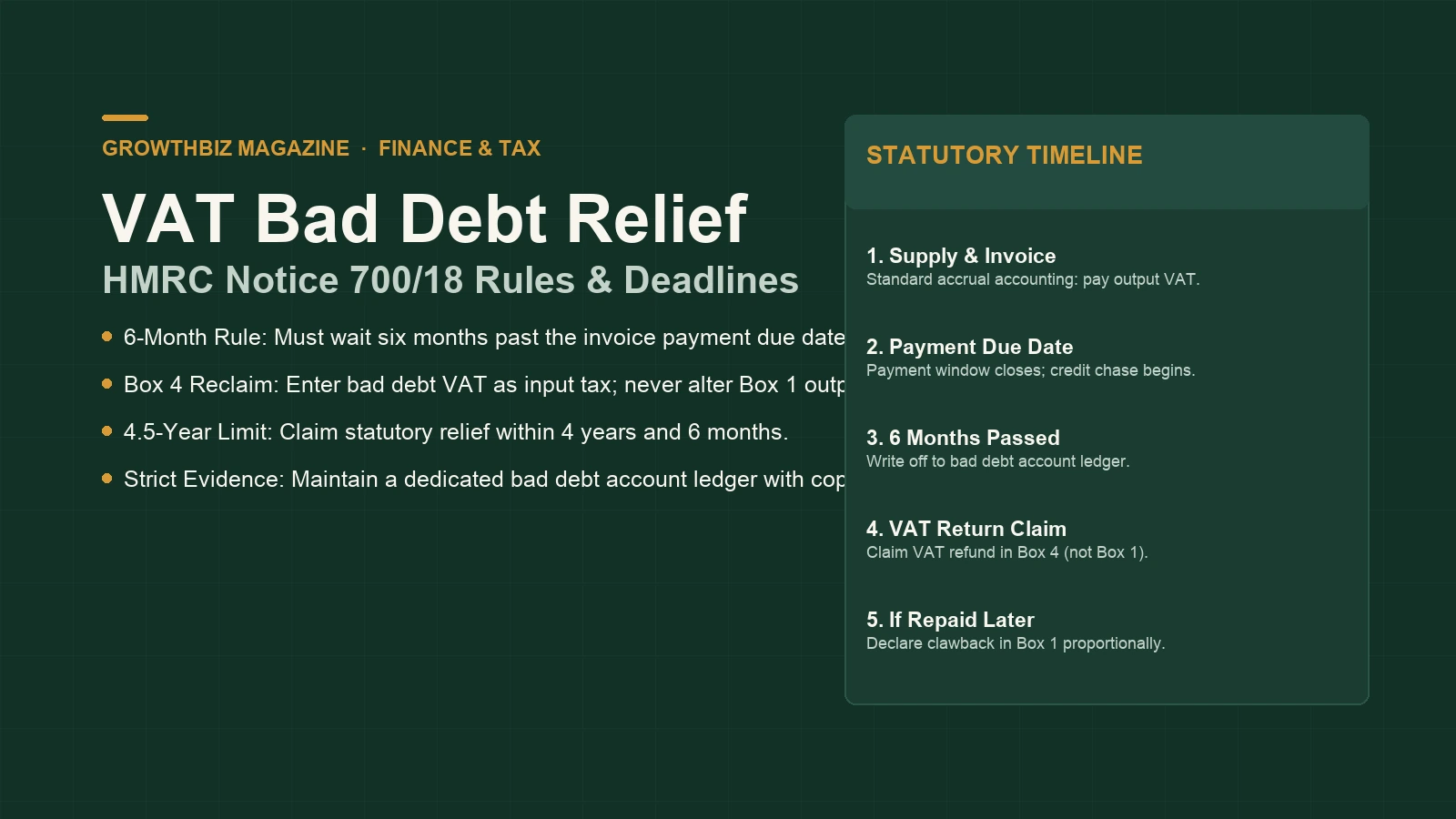
Under UK tax law, vat bad debt relief rules uk allow businesses to reclaim output tax paid on sales invoices that customers never settle. When you invoice on standard accrual accounting, you pay VAT to HMRC even if the client defaults. If the bill stays unpaid after six months, statutory relief returns that cash to your firm.
This guide is for UK small business owners, directors, and finance teams. Unpaid bills hurt cash flow. Dead debt ties up capital. Following statutory HMRC rules ensures you recover tax quickly without triggering compliance audits. Act promptly.
Statutory conditions under HMRC Notice 700/18
HM Revenue and Customs sets strict rules under HMRC Notice 700/18 before any business can claim relief. Four legal tests apply. First, you must have already accounted for and paid the output VAT to HMRC on an earlier return. You cannot reclaim tax you never paid.
Second, you must have written off the debt in your day-to-day accounts. Write it off. The debt must sit in a dedicated bad debt account. Third, at least six months must have passed since the date of supply or the payment due date, whichever came later.
Finally, the debt must not have been sold, factored, or assigned under a legal agreement that bars relief. Protect your position. If you follow our late invoice payment chase plan, you will have the paper trail HMRC requires.
The six-month waiting rule and claim deadlines
The statutory six-month clock begins on the payment due date. Mark your calendar. If an invoice issued on 1 January had 30-day payment terms due on 31 January, the six months expire on 31 July. You cannot claim on 1 July. Waiting out the full period is mandatory.
Section 36 of the Value Added Tax Act 1994 also sets an outer deadline. You must make the claim within four years and six months of the payment due date or date of supply. Time limits apply. After that statutory date, the claim expires permanently.
Missing this window forfeits the tax. Check old receivables regularly. Reviewing ledgers alongside our four-week cash-flow forecast prevents overdue claims from slipping past the deadline.
How to claim bad debt relief on your VAT return
Many business owners make the mistake of reducing their sales or altering output tax in Box 1. Never alter Box 1. HMRC rules explicitly forbid this method. Changing Box 1 distorts turnover figures and triggers automated compliance reviews.
Instead, claim bad debt relief by adding the VAT amount into Box 4. Enter it in Box 4. Box 4 tracks VAT reclaimed on purchases and other inputs. You also include the net invoice value in Box 7 total purchases. Box 1 and Box 6 remain completely untouched.
Do not issue a credit note to write off bad debt. Avoid credit notes. Issuing a credit note implies the original supply was void or discounted. If the customer genuinely received the goods or services, credit notes violate tax regulations.
Worked timeline example for UK VAT bad debt claims
Tracking the statutory waiting period and filing window requires clear calendar milestones. Key dates matter. The schedule below illustrates how a small supplier manages an unpaid £6,000 net invoice carrying 20 percent VAT (£1,200).
Labelled example: HMRC Notice 700/18 statutory timeline and bad debt relief accounting schedule.
| Milestone Step | Calendar Date | Invoice Status | VAT Action | Reporting Box |
|---|---|---|---|---|
| Supply & Invoice | 10 March 2026 | £7,200 gross invoice issued (30-day terms) | Output VAT £1,200 accounted for | Box 1 & Box 6 |
| Payment Due Date | 9 April 2026 | Customer invoice becomes overdue | Credit control chase underway | No VAT return entry |
| 6-Month Threshold | 9 October 2026 | Debt written off in company ledger | Statutory relief window opens | Enter in Bad Debt Account |
| VAT Return Claim | Period ending Nov 2026 | Debt remains completely unpaid | Claim £1,200 input tax relief | Box 4 & Box 7 |
| Subsequent Recovery | 15 February 2027 | Customer settles £3,600 (50% payment) | Repay £600 VAT back to HMRC | Box 1 output tax |
Review the timeline entries. Default triggered relief. Because the client defaulted, the firm waited until 9 October 2026 before entering the claim. The subsequent partial recovery required a proportional repayment to HMRC.
When drafting customer contracts, as outlined in our commercial payments contract checklist, setting clear credit terms ensures the statutory clock starts on a definite date. Terms protect cash.
The bad debt account ledger and evidence rules
HMRC requires every claimant to maintain a separate bad debt account ledger. Casual notes fail. Your bad debt record must show the exact invoice date, customer name, net sum, VAT charged, and the VAT period when output tax was originally paid.
You must also document the date the debt was written off and the return period on which relief was claimed. Keep copy invoices and delivery notes. If an inspector calls, you must produce these files promptly.
Store these records for six full years. Retain every document. Following the guidelines in our guide on how long to keep business records ensures your audit file remains fully compliant.
Handling customer repayments and clawback rules
Sometimes a customer pays after you have already claimed bad debt relief. Repayments happen. When this happens, HMRC clawback rules apply. You must refund the relevant portion of VAT to HMRC on your next VAT return.
If the customer pays the entire outstanding balance, you must repay the full relief amount in Box 1. Repay in Box 1. If they pay only part of the bill, calculate the proportion. Multiply the payment received by the original tax fraction to find the sum due.
Declare that repayment in Box 1 on the return covering the date payment arrived. Managing these liabilities alongside our advice on VAT registration rolling twelve months keeps your tax reporting accurate across every quarter. Keep returns clean.
Why the Cash Accounting Scheme avoids bad debt claims
Small businesses with annual taxable turnover up to £1.35 million can join the VAT Cash Accounting Scheme. Schemes differ. Under cash accounting, you only declare output VAT when a customer actually pays you.
Because you never pay HMRC on unpaid invoices, you never need to claim bad debt relief. Cash accounting helps. Bad debts handle themselves automatically. If cash flow is tight and customers pay slowly, cash accounting eliminates the six-month wait entirely.
Switching schemes requires careful planning. Check your books. Evaluate your customer payment habits. Choosing the right accounting method protects firm working capital before credit risks emerge.
Sources and scope
GOV.UK: Relief From VAT on Bad Debts (Notice 700/18) · Legislation.gov.uk: Value Added Tax Act 1994 Section 36 · GOV.UK: VAT Cash Accounting Scheme Rules. This article provides general financial and compliance guidance for UK VAT-registered businesses. Rules can change. Consult a qualified chartered accountant or VAT specialist for advice on your specific circumstances.