- Save up to £5,000 yearly.
- The Employment Allowance lets UK firms cut employer tax bills across monthly payroll runs.
- Sole director companies with no other employees are barred from claiming statutory tax relief under current legislation.
- Hiring a second worker unlocks relief.
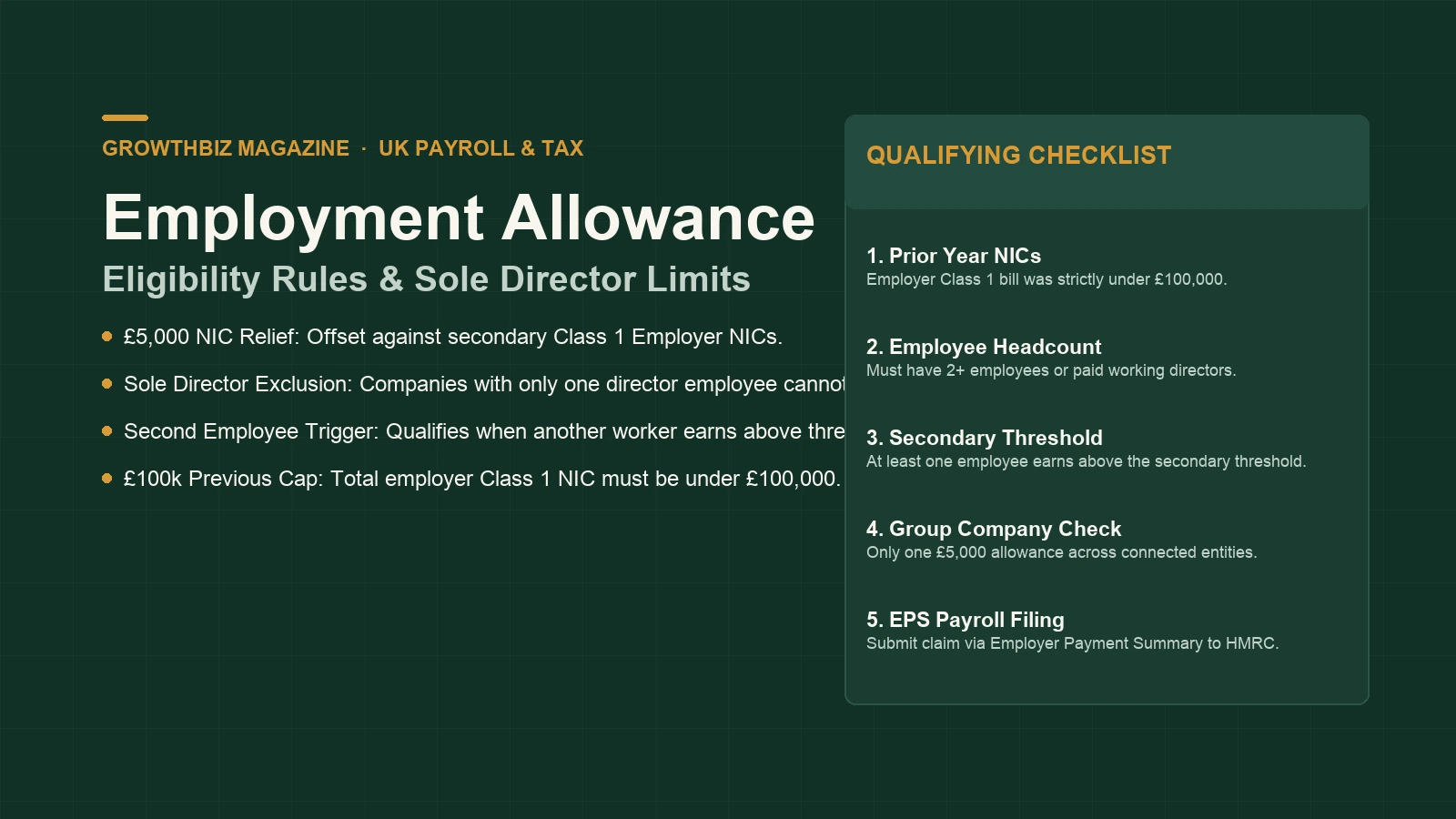
Under UK tax law, employment allowance eligibility rules uk let small firms cut payroll costs. Eligible firms can trim their annual employer Class 1 National Insurance bill by up to £5,000 during the active tax year. Sole director firms cannot claim. You must meet clear payroll tests before asking HMRC for tax relief.
This guide is for UK small business owners and directors. Payroll tax eats cash reserves. Costs keep rising. Following clear HMRC guidelines helps you claim legal tax relief without fines. Check your payroll today.
Employment allowance eligibility rules UK: who qualifies
To qualify for relief, your firm must employ staff. Check old tax bills. Under HMRC rules, your total employer Class 1 NIC bill must have stayed below £100,000 in the prior tax year.
If your past bill hit £100,000 or more, you cannot claim. The cap applies strictly. Linked firms must add their totals together. If the joint bill hits £100,000, all firms lose out.
The allowance trims employer Class 1 dues month by month. Relief applies quickly. It runs until the £5,000 allowance is fully used or the tax year ends. You cannot trim staff deductions or Class 1A dues.
The sole director exclusion rule explained
Single director firms face clear legal tests. Rules block claims where a firm has only one worker and that person is a named director. Lawmakers set this rule to stop one person contractor firms from claiming. Spouses must do real work.
Many small firms run with one sole director taking a small wage. In that case, the firm cannot claim the allowance. Paper additions fail audits.
The ban lifts once a firm takes on real staff. Hiring a second worker who earns above the secondary wage limit unlocks the relief. Managing wage splits alongside our guide on directors loan account s455 tax helps directors keep tax forms clean.
When taking on a second worker unlocks eligibility
To lift the single director bar, your firm must employ at least one extra worker. Timing matters. That second person can be another working director or a regular worker on the payroll.
The second worker must earn enough to trigger employer Class 1 tax. Wages must cross the line. If the second worker earns below the secondary pay limit, no employer tax arises. In that case, relief cannot be claimed.
Once eligible, the relief covers employer tax across all qualifying staff. Plan payroll carefully. If you hire part-time staff, review our guide on statutory sick pay qualifying days to set up sound job records.
Connected companies and group business restrictions
Owners who run several firms cannot claim multiple sums. One claim applies per group. If two or more limited firms are linked, they must share a single £5,000 allowance between them.
Firms are linked if one firm controls another, or if both firms are run by the same person. The firms can choose which shop claims the relief. Dividing the sum is barred.
Check your group company setup often. Corporate changes happen. Reviewing firm links alongside our guide on VAT registration rolling twelve months keeps group firms safe across all tax thresholds.
Worked decision matrix for UK Employment Allowance eligibility
Checking whether your payroll qualifies means reviewing headcount and past tax bills. Rules differ by setup. The matrix below shows how different small business setups qualify for the £5,000 relief under UK tax rules.
Labelled matrix: UK Employment Allowance qualification criteria and employer National Insurance relief outcomes.
| Company Operating Structure | Prior Year NIC | Qualifying Headcount | Eligibility Status | Maximum Relief |
|---|---|---|---|---|
| Sole Director (No Other Staff) | Under £100,000 | 1 director only | Excluded by statute | £0 annual relief |
| Sole Director + 1 Part-Time Employee | Under £100,000 | 1 director + 1 worker above threshold | Fully eligible | Up to £5,000 per year |
| Two Paid Working Directors | Under £100,000 | 2 directors on commercial payroll | Fully eligible | Up to £5,000 per year |
| Connected Group (Three Limited Cos) | Under £100,000 total | Multiple qualifying staff | One entity claims | £5,000 shared total |
| Mid-Sized Employer (Large Team) | £100,000 or above | 50 employees | Disqualified by cap | £0 annual relief |
Review the matrix rows carefully. Headcount drives outcome. Notice that adding a genuine second worker transforms an excluded sole director firm into a qualifying employer. The business can then offset up to £5,000 against monthly employer National Insurance liabilities. Cash savings help growth.
Before changing payroll, verify that your firm keeps sound cash records. Using our four-week cash-flow forecast ensures payroll tax savings feed directly into sustainable cash reserves.
How to submit your claim through payroll software via EPS
Claiming the Employment Allowance is simple when running payroll. Paper forms are not used. Instead, you claim in your payroll software by sending an Employer Payment Summary.
Select the option confirming that you want to claim the allowance on your first payroll run of the tax year. Submit the form. Software stops taking tax.
You can submit a claim at any point during the tax year. If you claim late, HMRC will offset the relief against existing debts or issue a refund. Retain payroll records and submission slips following our guide on how long to keep business records to ensure complete audit compliance.
Sources and scope
GOV.UK: Claim Employment Allowance Eligibility · GOV.UK: Single-Director Companies and Employment Allowance · Legislation.gov.uk: National Insurance Contributions Act 2014. This article provides general tax guidance for UK employers. Payroll rules can change. Consult a qualified chartered accountant, payroll specialist, or tax adviser for advice on your specific business payroll circumstances.