- Set authority before money moves.
- Match the approval route to the amount, budget and risk.
- Keep one request record from need to payment.
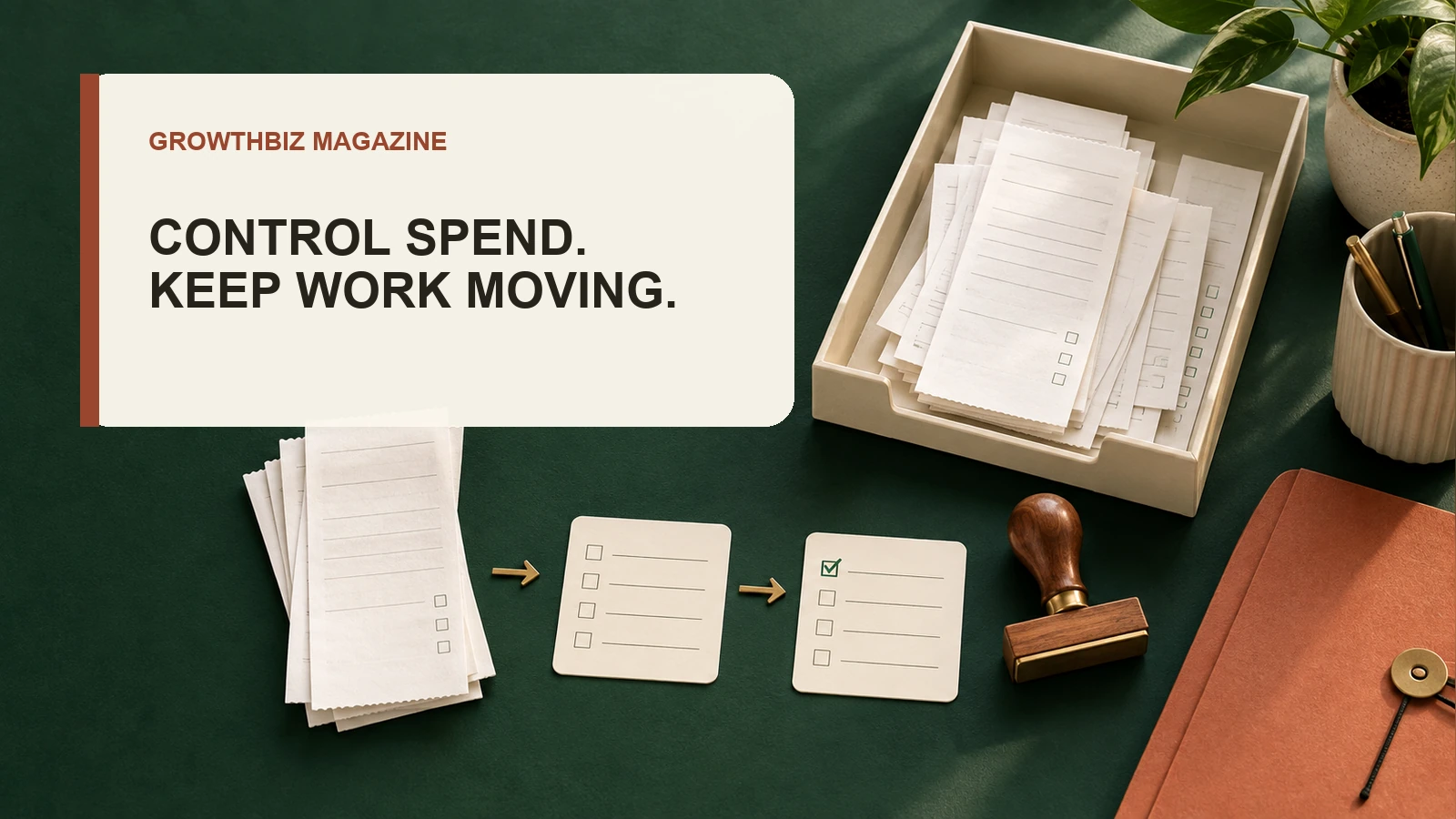
A small expense can waste more time than money. One person asks in chat, another buys the item and the owner later searches for the receipt. The cost may be valid, yet nobody can see who approved it or which budget paid for it.
An expense approval policy fixes that handoff. It does not need to be a thick rulebook. A one-page policy can show who may request, approve, pay and review each type of spend.
Start with the decision, not the form
Write down the problem the policy must solve. You may need to stop self-approval, protect a cash limit, collect evidence or give a manager freedom to handle routine costs.
Keep purchase requests and reimbursements distinct. A purchase request asks for permission before the business commits money. A reimbursement asks the business to repay a cost that someone has already paid.
If a supplier order is the main issue, connect the policy to the small-business purchase order process. The approval policy sets authority. The purchase order records what the business agreed to buy.
Name four roles
Use role names, not just employee names. Staff changes should not make the policy unclear.
- Requester: The requester explains the business need and expected cost.
- Approver: The approver checks authority, budget, evidence and timing before the request moves.
- Payer: The payer releases the card, transfer or reimbursement after approval.
- Reviewer: Checks records against accounts and bank activity.
One person may hold more than one role in a very small firm. Still, avoid having the claimant approve the same expense when another responsible person can check it.
HMRC says employees cannot check their own expenses under its exemption rules for certain reimbursed costs. The rule also asks employers to keep a checking system and tell staff to retain proof such as receipts or bills. US and UK tax treatment differs, so confirm the local rules that apply to your business.
Build an approval matrix
A matrix routes spend by amount and context. It should answer three questions: Is the cost budgeted? Is it routine? Who has authority at this level?
| Spend band | Example route | Evidence |
|---|---|---|
| Routine, up to $250 or £200 | Named team lead | Purpose and receipt |
| $251–$1,000 or £201–£800 | Operations or finance lead | Request, budget line and quote |
| Above $1,000 or £800 | Owner or director | Request, options and cash impact |
| Out of budget or unusual | Owner at any amount | Reason, funding source and exception note |
Labelled example: The amounts above illustrate a routing design for a small service firm. They are not legal, tax or accounting thresholds. Replace them with limits that match your cash position, team roles and normal purchase size.
Do not set limits only by amount. A low-cost subscription can renew every month. A new supplier may change delivery risk. Personal data, customer promises or safety concerns may need a specialist check even when the price is small.
Define what must appear on every request
Ask for enough information to make the decision once. A useful request record contains the requester, date, business purpose, supplier, amount or range, budget line, needed-by date and evidence.
Add the approver, decision, decision date and any condition. Keep the payment reference with the same record. This gives the reviewer a path from need to approval and payment.
The IRS says business records should support amounts entered in the books and tax return. Its examples of supporting documents include invoices, receipts, paid bills, account statements and card slips. UK business guidance likewise calls for accurate records of money moving in and out, including receipts, purchase orders and invoices.
Write a pre-approval rule people can follow
State which costs need approval before anyone commits the business. Common examples include unbudgeted work, equipment, new software, long contracts and any amount above a role's limit.
Then name the fast lane. Routine costs within a person's budget and limit may move without an owner reply if the record is complete. This keeps control from becoming delay.
A quote can expire while a request waits. Use the quote validity guide to record what may change before the approval date.
Create a separate exception route
An urgent purchase should not disappear into a chat message. Give emergencies a short route: who may act, the temporary limit, the reason and the deadline for adding evidence.
Do not label poor planning as an emergency. Review repeated exceptions each month. Several urgent courier fees may point to a stock, scheduling or supplier problem.
If the same cost keeps surprising the team, run the 60-minute cost audit. Put any approved recurring amount into the working business budget.
Handle reimbursements with local rules in view
For US employers, the IRS 2026 Employer's Tax Guide says an accountable plan requires a business connection, timely proof of the expense and return of any excess advance. If those tests are not met, the payment may be treated differently for payroll tax purposes.
In the UK, expense and benefit reporting depends on the type of cost and how it is paid. Your internal approval does not decide whether a cost is deductible or exempt. Use current official guidance or a qualified adviser for that question.
Your policy can still make the process clear. State the submission channel, required proof, review owner and expected payment run. Avoid promising a tax result in the policy.
Test the policy for 30 days
Choose one start date and one place for requests. Explain the limits with two examples: a routine approved cost and an unusual cost that needs escalation.
After 30 days, review missing receipts, slow decisions, self-approval, duplicate subscriptions and repeated exceptions. Change the rule that caused confusion. Do not add fields that no decision used.
The final page should be easy to scan. Include scope, roles, approval bands, evidence, exceptions, payment timing and the policy owner. Add a review date so old limits do not live forever.
Frequently asked questions
What is an expense approval policy?
It is a short set of rules that says who may request, approve, pay and review business spending, plus what evidence each step needs.
Should every expense need owner approval?
No. A small business can give named roles authority for routine, budgeted spending while reserving larger, unusual or out-of-budget costs for the owner.
Can an employee approve their own expense?
Use a different approver whenever the team structure allows it. UK rules for certain exempt employee expenses expressly say employees cannot check their own claims.
How often should the policy be reviewed?
Review it after the first month, then on a fixed schedule and whenever roles, budgets, payment tools or recurring costs change.
Sources and scope
IRS Publication 15 (2026): employee business expense reimbursements · IRS Publication 583: business records and supporting documents · HMRC: exemptions and checking expenses · Business.gov.uk: accounting records. This article gives general operating guidance, not legal, tax or accounting advice. Approval amounts are labelled examples, not universal thresholds.