Payment terms are not a line added to an invoice at the end of a job. They are a decision about how much of a client’s project your business can afford to finance.
For a small service business, the safest starting point is simple: agree the schedule before work begins, show a real calendar date, make payment easy, and do not let the next stage of work get too far ahead of the last payment. A long-standing client with a reliable approval process may earn more flexibility. A new client, a large fixed-fee project, or work that cannot be reused usually needs a deposit or milestone payment.
This is not about treating every client with suspicion. It is about making the promise clear while the relationship is still easy. Clear terms prevent the awkward version of the conversation later, when the work is done and the invoice is already overdue.
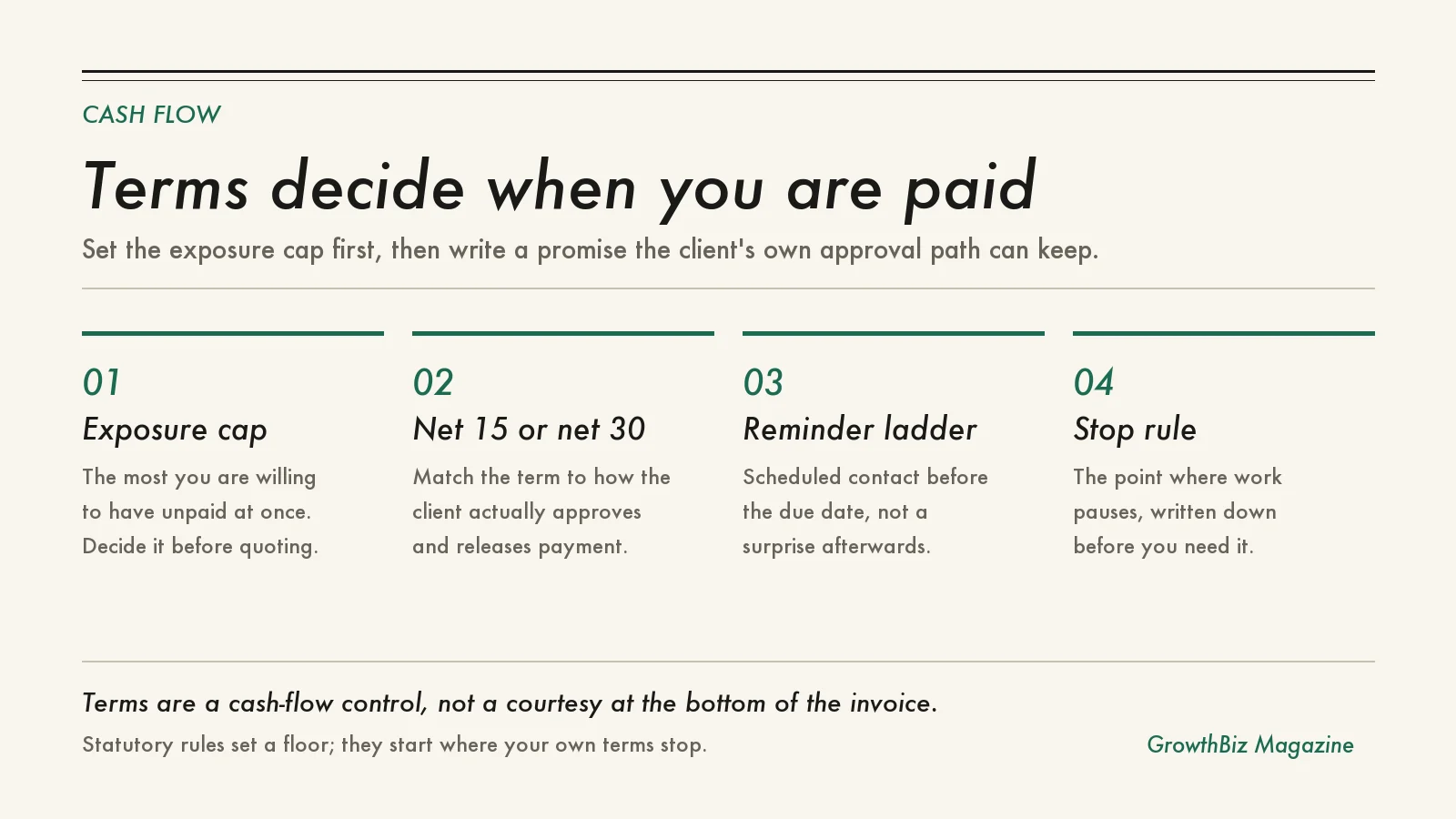
Start with your maximum unpaid exposure
Before choosing “net 15” or “net 30,” decide the largest amount of unpaid work you can safely carry for one client. That number should include work already delivered, work in progress, and project costs you cannot recover. Call it your exposure limit.
For example, a two-person design studio may be able to carry $3,000 of completed work for an established client without putting payroll under strain. A $15,000 website project is different. If the studio agrees to collect only at the end, it may spend weeks of labour and buy specialist work before receiving anything. A deposit and two milestones reduce the amount at risk at any one time.
This is the gap many invoice-term guides miss. They explain which words to put on an invoice. They do not ask whether the business can afford to be one full project behind on cash.
| Project situation | Safer starting structure | What it protects |
|---|---|---|
| Small, repeat work for a reliable client | Invoice on completion with a clear short due date. | Keeps administration simple while the unpaid balance stays small. |
| New client or unclear approval process | Deposit before booking time; balance on delivery or a short agreed term. | Protects the first block of labour and confirms the client can pay. |
| Large fixed-fee project | Deposit plus milestones tied to real handover points. | Stops the business from funding the whole build. |
| Ongoing monthly service | Invoice at the agreed point each month; pause new scope if an old invoice is overdue. | Prevents one late cycle becoming two or three. |
The percentages are less important than the sequence. A milestone should match a useful piece of work: discovery complete, a first deliverable accepted, or a launch handover. Avoid vague checkpoints such as “when we are nearly finished.” They invite arguments when the client and supplier see progress differently.
Write a payment promise a client can actually follow
“Net 30” may be familiar to an accounts team, but it is still weaker than a plain sentence with a due date. Put the same promise in the proposal or contract, the accepted quote, and the invoice. If any of those say different things, the client has a reason to delay while the two sides sort it out.
A usable payment promise answers five questions:
- What is due? State the amount or the percentage for this stage.
- When is it due? Use a calendar date, not only an abbreviation.
- What must happen before it is due? Name the agreed milestone, if there is one.
- How can the client pay? Give the approved method, bank details or payment link, and purchase-order information if needed.
- What happens if it is late? Say who will contact whom and whether new work pauses. Get local legal advice before relying on fees, interest, or collection wording.
For a project with three stages, a plain version might read: “Forty percent is due to reserve the project. Thirty percent is due when the first agreed design direction is delivered. The final thirty percent is due before launch handover. Each invoice is due on the date shown.” The client still needs to agree to it; an invoice alone is not a substitute for an agreed scope.
Match the term to the client’s approval path
Some clients can pay a card link on the same day. Others need a purchase order, a named approver, and a monthly payment run. Asking the right questions early is often more useful than arguing about a shorter term later.
- Who approves the invoice, and what name or reference must appear on it?
- Does the client need a purchase order before work starts?
- Which payment method can they use without delay?
- Is there a regular payment run that affects the actual date?
- Who should receive the invoice and reminder if the project contact is away?
Send a correct invoice promptly after the agreed milestone. An incorrect invoice, missing purchase-order reference, or unclear description can send it back for rework. A late invoice also gives the client one more reason to move your bill to the next payment run.
Use a reminder ladder, not a surprise
Chasing payment feels personal when there is no process. Make it routine instead by turning the reminder ladder into a simple one-page SOP. The wording can stay polite because the action is already agreed.
| Moment | Practical action | Purpose |
|---|---|---|
| When the invoice is sent | Send it to the agreed contact, with the due date and payment route visible. | Confirms the invoice entered the right process. |
| A few days before due date | Send a short courtesy reminder and ask if anything is missing. | Catches approval or purchase-order issues early. |
| On the due date | Confirm the invoice is due today and restate the payment method. | Removes ambiguity without sounding accusatory. |
| After the due date | Ask for a specific payment date; follow the agreed pause rule if it is not resolved. | Prevents the balance from quietly growing. |
The exact timing should fit the client and the work. The important part is consistency. Do not make exceptions by accident because a project manager sounds busy. If you choose to extend a date, record the new date in writing and decide whether any new work should wait.
Set a stop rule before you need one
A stop rule is not a threat. It is an operating boundary: “We can continue current support, but we will not start the next agreed stage while the previous invoice is overdue.” The rule is easiest to uphold when it was visible from the beginning.
Use it with judgment. A trusted client may have a genuine processing error. But do not solve that error by adding another month of unpaid work. Ask what is blocking payment, who owns the fix, and the date it will be resolved. If the answer is vague, hold the next piece of non-urgent work.
This protects more than cash. It keeps the team from promising delivery dates it cannot responsibly meet. It also makes your sales forecast more honest: booked work is not the same thing as cash that will arrive in time to pay people and suppliers.
Know where legal rules begin
Payment rights and late-payment remedies vary by country, contract, and customer type. This article is an operations guide, not legal advice. If you sell in the UK, GOV.UK says businesses can set their own payment terms; where no payment date is agreed, the customer generally must pay within 30 days of receiving the invoice or goods or service. The Office of the Small Business Commissioner explains that longer private-sector terms may be agreed when they are fair, while public-sector organisations have a 30-day requirement after receipt and acceptance.
Do not copy a late-fee clause from the internet and assume it applies to your business. Check the rules that apply where you trade and get qualified advice for a disputed invoice, a regulated service, cross-border work, or a contract with a large customer.
A 20-minute payment-terms check
- List your three largest current or upcoming jobs.
- For each one, add the cost and labour you would carry before the next payment.
- Compare that number with your exposure limit and next payroll or supplier commitment.
- Check that the quote, agreement, invoice, and project plan use the same due date and milestone names.
- Write the reminder dates and the point where new work pauses.
- Before the next project starts, ask the client about purchase orders, approvers, and payment runs.
A business does not need harsh terms to protect cash flow. It needs terms it can explain, apply, and afford. When the schedule is clear from the first conversation, good clients usually see it as normal professional practice.
Frequently asked questions
Should a small service business always ask for a deposit?
Not always. A deposit is most useful when the client is new, the work is large, the delivery costs are high, or the work cannot be reused. The key is to avoid carrying more unpaid work than the business can safely fund.
Is net 30 always too long for a small business?
No. It can work for a reliable client when the unpaid amount fits your cash plan. The problem is not the label alone; it is agreeing to a full project’s worth of unpaid labour without checking the exposure.
What should I do when a client says the invoice is not in their system?
Ask what exact information is missing, who can confirm receipt, and when it will be added. Send a corrected invoice quickly if needed, record the revised date in writing, and avoid starting the next non-urgent stage until the issue is resolved.