A business can spend less on ads and still pay more to win each customer. Another firm may spend more and get a better result.
Customer acquisition cost helps you see the difference by turning sales and marketing work into one number you can track.
The formula is simple, but the hard part is choosing honest costs and the right customer count.
What customer acquisition cost means
Customer acquisition cost is often shortened to CAC. It is the average sales and marketing cost used to gain one new paying customer in a set period.
A customer is not a website visit, social follower, email sign-up, or sales lead; the person or firm must complete the step that your business counts as a sale.
This point matters because a campaign can collect many cheap leads but very few buyers. CAC keeps the final result in view.
The U.S. Small Business Administration says a marketing plan should include a full cost breakdown and should compare marketing and sales costs with the revenue they produce. Business Wales also tells firms to track customers, where enquiries came from, and the cost of getting customers.
Use the basic CAC formula
The basic formula is:
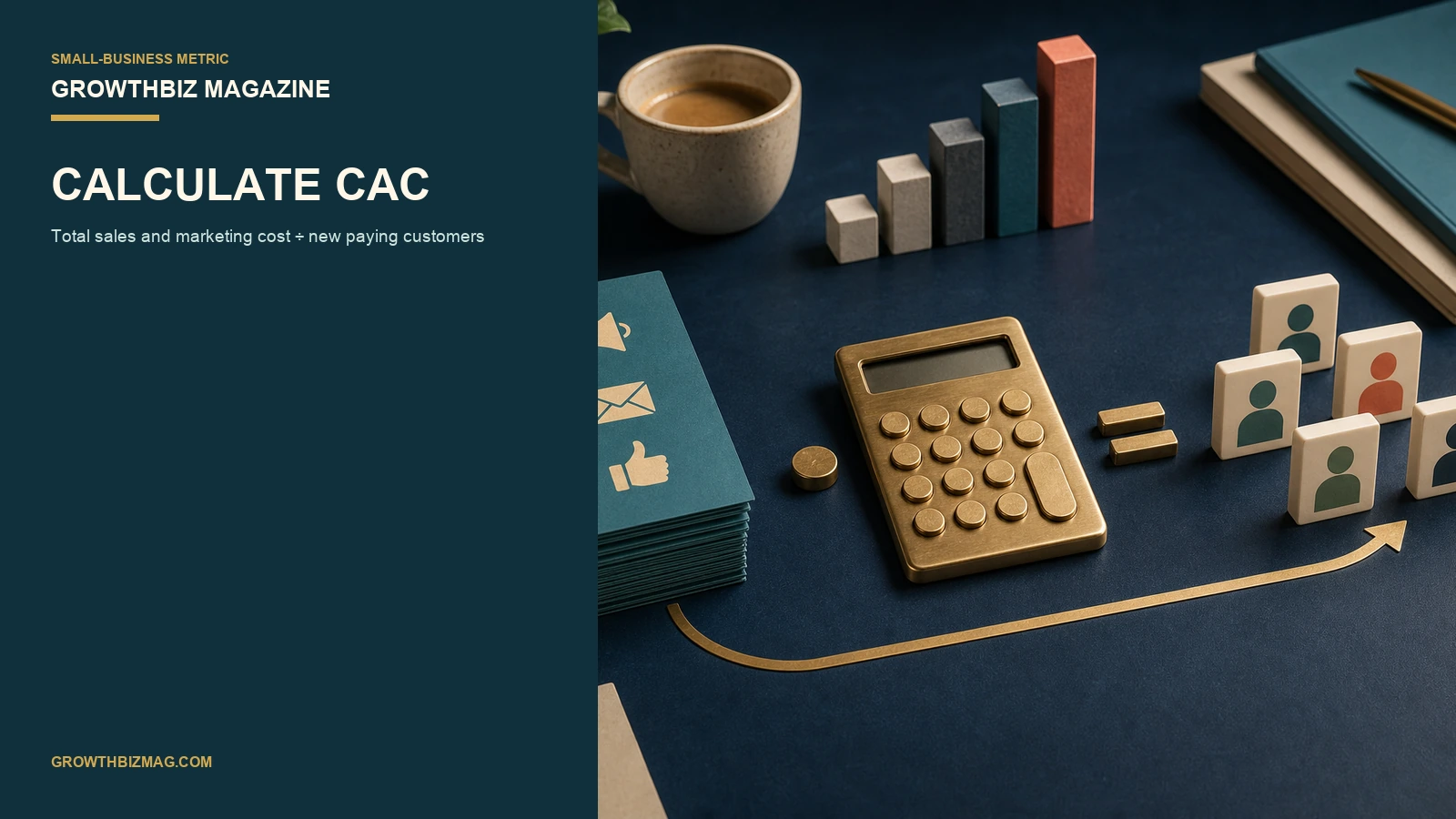
Customer acquisition cost = total sales and marketing cost ÷ new paying customers
Use the same time period on both sides, which means that costs from April through June must be matched with new customers from April through June.
For example, a local service firm spends $4,200 or £4,200 on sales and marketing during one quarter. It wins 35 new paying customers.
Its CAC is 4,200 divided by 35, which equals 120. The firm spent an average of $120 or £120 to win each new customer.
This is an average, not the exact cost of each sale, because some buyers came through a paid ad while others came from search, a referral, an event, or direct sales work.
Count the full cost
Ad spend alone is not a full CAC, so include the work and tools used to win the customer.
| Cost group | What may belong in CAC |
|---|---|
| Media | Search ads, social ads, print, direct mail, sponsorships, and event space. |
| People | Sales and marketing pay, commissions, agency fees, freelance work, and a fair value for owner time. |
| Creative work | Writing, design, photos, video, landing pages, and sales material. |
| Tools | Email, customer records, call tracking, booking tools, and reporting software. |
| Sales support | Samples, demos, travel, postage, and other work used to close a new sale. |
Choose a clear rule for shared costs, such as counting 50% of a staff member's pay when half of that person's time supports new sales.
Use the same rule next month or next quarter because a steady rule makes the trend easier to trust.
Our guide to a small-business marketing budget can help you list these costs before a test begins.
Count new customers, not all orders
The bottom half of the formula should include new paying customers only, which means repeat orders from existing customers do not belong there.
One new customer may place three orders during the period, but that is still one new customer for the basic CAC measure.
Decide how your records identify a new customer, such as an email address, account number, phone number, or customer record; keep the rule simple and protect private data.
Returns and cancelled orders need a rule too, so a firm may wait until the return period ends before it counts the buyer as a new customer.
This is slower, but it stops a burst of weak or cancelled sales from making CAC look better than it is.
Match cost with the sales cycle
A same-month CAC works best when buyers decide fast, but it can mislead a firm with a long sales cycle.
A consultant may pay for an event in April, meet a buyer in May, and close the work in July; if the April cost is compared only with April customers, the result will look too high.
Use a quarter, six months, or another window that fits the usual time from first contact to sale, and apply it in the same way each time.
You can also track a simple group of leads from first contact to sale. This gives a clearer view when timing changes often.
A simple sales forecast can help you see when open deals may turn into real orders.
Calculate CAC by channel with care
A company-wide CAC shows the broad cost of growth. A channel CAC asks what it cost to win customers from search, email, referrals, events, or another source.
Channel CAC can guide choices, but only when both the cost and customer source are known. Do not give every sale to the last link a buyer clicked if earlier work helped create the demand.
Use tagged links, call records, booking questions, sales notes, and customer surveys to build a fair picture.
Keep an “unknown” group when the source is not clear because made-up precision is worse than an honest gap.
Start with the channels that use the most cash. Our guide to choosing one marketing channel explains how to run a focused test.
Compare CAC with what a customer adds
CAC is not a score that should be as low as possible, since a higher CAC can work when those customers add more profit and stay longer.
First, estimate the sales value from a customer, then remove the direct costs needed to deliver the product or service.
For service firms, the guide to gross margin explains how labour and delivery tools affect the amount left.
Also check when cash arrives because a customer may look valuable over a year but still create a cash gap if the business pays to win and serve the buyer months before payment.
There is no safe CAC for every firm. Price, margin, repeat sales, refunds, payment speed, and risk all change what the business can carry.
A simple monthly or quarterly review
Write down five items at each review: the period, total cost, new customers, CAC, and the rule used for shared costs.
Then ask what changed: did ad prices rise, did staff time grow, did more leads turn into buyers, or did one large event cost sit in this period?
Do not act on one odd week. Look for a pattern and check customer quality before moving a large amount of money.
A useful CAC measure is not perfect, but it is clear, steady, and good enough to support the next choice.
Frequently asked questions
What is customer acquisition cost?
Customer acquisition cost, or CAC, is the average sales and marketing cost used to win one new paying customer during a set period.
What costs should a small business include in CAC?
Include ads, sales and marketing pay, agency or freelance work, creative work, software, events, commissions, and other costs used to win new customers. Use the same rule each period.
How often should a small business calculate CAC?
A monthly check can suit a fast sales cycle. Use a quarter or a longer period when sales take more time. The costs and new customers must cover the same period.