- HMRC divides statutory profit thresholds by the total count of connected firms.
- Limits split equally.
- Businesses fall under these rules when one controls the other or both share ownership.
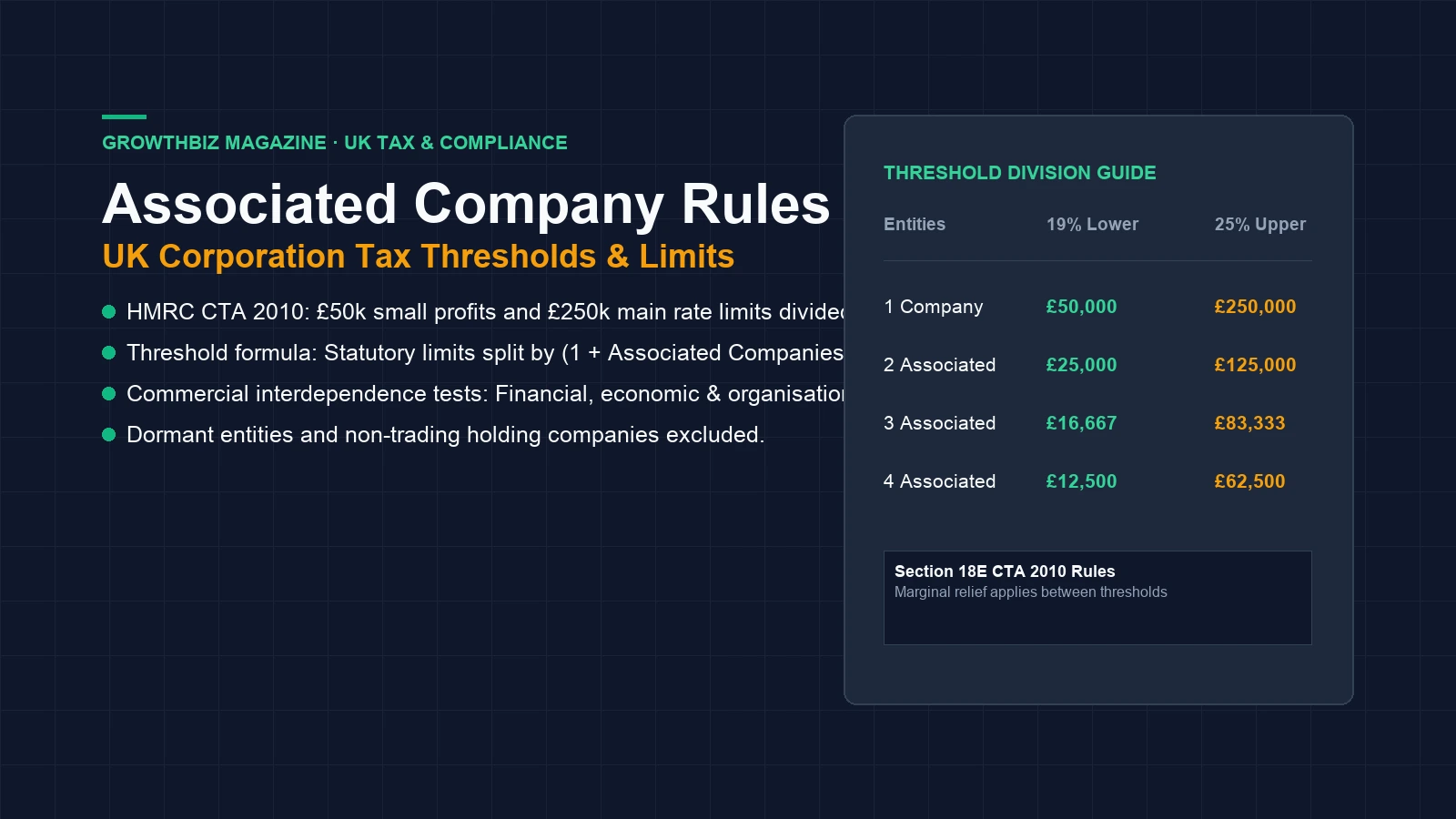
Associated company rules uk corporation tax divide statutory profit bands among active businesses under shared control. Statutory limits split equally. Under Section 18E of the Corporation Tax Act 2010, thresholds divide across connected firms.
The divisor includes every active venture. A director running two active ventures faces a lower band of £25,000 for each business. Each firm also receives a £125,000 upper limit.
This statutory rule stops owners from splitting one trading firm into multiple corporate shells. Without it, owners could claim the 19 percent rate across several entities. Profits above the lower band face marginal relief. That raises the effective tax rate toward 25 percent on profits in that middle band. Learning how limits divide protects business cash flow.
How HMRC defines associated companies under CTA 2010
Two entities become associated when one controls the other. They link under shared control. Control means holding over 50 percent of voting power, shares, or winding up assets. This legal test comes from Section 18E. Inspectors assess beneficial ownership across all direct and indirect holdings.
The rules apply if shared control lasts for even one day in a financial year. A brief link binds both firms. If you take shareholder loans as well, review our guide on directors loan account s455 tax for compliance. Holding groups do not block association. Tax inspectors look through corporate layers to identify ultimate beneficial owners.
How associated company rules divide corporation tax thresholds
In the UK, trading firms with taxable profits up to £50,000 pay the 19 percent small profits rate. Profits above £250,000 face 25 percent. Profits between those marks pay the main rate minus marginal relief. This creates a 26.5 percent rate. When connected firms exist, HMRC divides both statutory limits equally.
Three active firms get £16,667 lower limits. Each firm also receives an upper band of £83,333. Threshold division applies regardless of where trading profits arise. Allowances cannot transfer between firms.
| Active Trading Entities | Lower Threshold (19%) | Upper Threshold (25%) | Marginal Relief Range |
|---|---|---|---|
| 1 Firm (standalone) | £50,000 | £250,000 | £50,001 to £250,000 |
| 2 Associated Firms | £25,000 | £125,000 | £25,001 to £125,000 |
| 3 Associated Firms | £16,667 | £83,333 | £16,668 to £83,333 |
| 4 Associated Firms | £12,500 | £62,500 | £12,501 to £62,500 |
| 5 Associated Firms | £10,000 | £50,000 | £10,001 to £50,000 |
Profits in one unit do not shift limits to another unit. If firm A earns £100,000 while firm B earns £2,000, firm A still gets the £25,000 lower limit. You cannot transfer unused allowances between connected ventures. Keep separate books for each venture.
Worked example: tax impact on £40,000 profit
Consider a director running firm A with £40,000 in annual taxable profit. As a standalone business with no connected entities, the full sum sits below £50,000. Firm A pays tax at 19 percent, producing a bill of £7,600. Now assume the owner opens firm B for consulting work. Both firms now count as associated.
Firm A sees its lower limit fall to £25,000. Its upper limit drops to £125,000. That leaves £15,000 of profit inside the marginal relief band. Firm A pays 19 percent on the first £25,000 (£4,750). On the next £15,000, the effective tax rate is 26.5 percent (£3,975).
Total tax climbs to £8,725. Owning two ventures adds £1,125 in tax on identical profit. Including this in your one-hour budget plan keeps cash projections accurate. Small firms must plan ahead.
The three commercial interdependence tests for family businesses
Confusion often surrounds ventures owned by spouses or family members. Rights held by spouses do not combine by default. HMRC links separate family ventures only when commercial interdependence exists. Inspectors review connections across three statutory headings.
| Interdependence Test | Evaluation Criteria | HMRC Risk Indicator |
|---|---|---|
| Financial Ties | One business provides loans or guarantees to support the other. | Inter-company debts, shared credit lines, or joint banking security. |
| Economic Ties | Both ventures share common commercial aims or market customers. | One firm gets over 50 percent of sales from the other. |
| Organisational Ties | Both enterprises share management, staff, premises, or plant. | Same registered office, shared staff, or identical payroll desks. |
First comes financial ties. This applies when one business provides loans or guarantees to support the other.
Second comes economic ties. This covers ventures sharing commercial aims or common customers. Third comes organisational ties. This applies when enterprises share staff, premises, or equipment.
If a spouse runs a bakery and their partner runs a software agency, they remain distinct. They need separate bank accounts and clients. When funding staff benefits, check our review of trivial benefit rules for directors uk to keep costs separate. Keep clean operational boundaries.
Dormant entities and non-trading holding company exemptions
Not every registered entity increases your divisor. HMRC excludes dormant businesses that carry on no trade during the financial year. A shelf entity kept to protect a brand name will not reduce your tax thresholds. Passive holding entities also qualify for exclusion under Section 18E. They must only collect dividend income.
If a holding unit charges fees or rents space, HMRC treats it as an active trade. Entities in formal liquidation stop counting once trading ends. Striking off unneeded shelf firms removes association risks cleanly. If trade approaches registration limits, consult our guide on vat registration rolling 12 months to track revenue. Clean company structures save tax.
Practical tax planning checklist for company directors
Before closing your financial accounts, work through five practical steps. List all active trading entities worldwide. Review family-owned ventures for financial, economic, or staffing ties that trigger association.
Strike off redundant dormant entities. Check quarterly tax installment dates if your divided upper profit limit drops. Confirm payroll records match our statutory sick pay qualifying days guide.
For official rate brackets, visit the HMRC Corporation Tax rates guidance. Review statutory rules in Section 18E of the Corporation Tax Act 2010 and HMRC Manual CTM03570. Take professional tax advice early.
Frequently asked questions
What are the associated company rules for UK Corporation Tax?
Associated company rules divide the £50,000 and £250,000 profit thresholds equally. All active trading firms under shared control share the allowance. This reduces the profit level where higher tax rates apply.
How does having two associated companies affect Corporation Tax thresholds?
If you control two firms, each receives a £25,000 lower threshold. Each firm also receives a £125,000 upper limit. Taxable profits above £25,000 face marginal relief rather than the flat 19 percent rate.
Do dormant companies count as associated companies?
Dormant companies do not count. Passive holding firms that do not trade during the accounting period are also excluded. Only active trading entities divide the statutory limits.
Does my spouse's company count as an associated company?
A spouse business only counts if commercial interdependence exists. HMRC tests financial, economic, and organisational ties. Completely independent businesses run by spouses remain separate.